

LTR-303 Digital Ambient Light Sensor
Basic Overview #
The LTR-303ALS-01 is a low voltage I2C digital light sensor [ALS] in a low cost miniature chipled lead-free surface mount package. This sensor converts light intensity to a digital output signal capable of direct I2C interface. It provides a linear response over a wide dynamic range from 0.01 lux to 64k lux and is well suited to applications under high ambient brightness. There are altogether six gain settings (1X, 2X, 4X, 8X, 48X and 96X) available for user to configure.
Feature List #
- I2C interface (Fast Mode @ 400kbit/s)
- Ultra-small 6-pin ChipLED package 2.0mm(L), 2.0mm(B), 0.7mm(H)
- Built-in temperature compensation circuit
- Low active power consumption with standby mode
- Supply voltage range from 2.4V to 3.6V capable of 1.7V logic voltage
- Operating temperature range from −30 °C to +70 °C
- RoHS and Halogen free compliant
- Close to human eye spectral response
- Immunity to IR / UV Light Source
- Automatically rejects 50 / 60 Hz lightings flicker
- Full dynamic range from 0.01 lux to 64k lux
- 16-bit effective resolution
Board Resources #
Function Description #
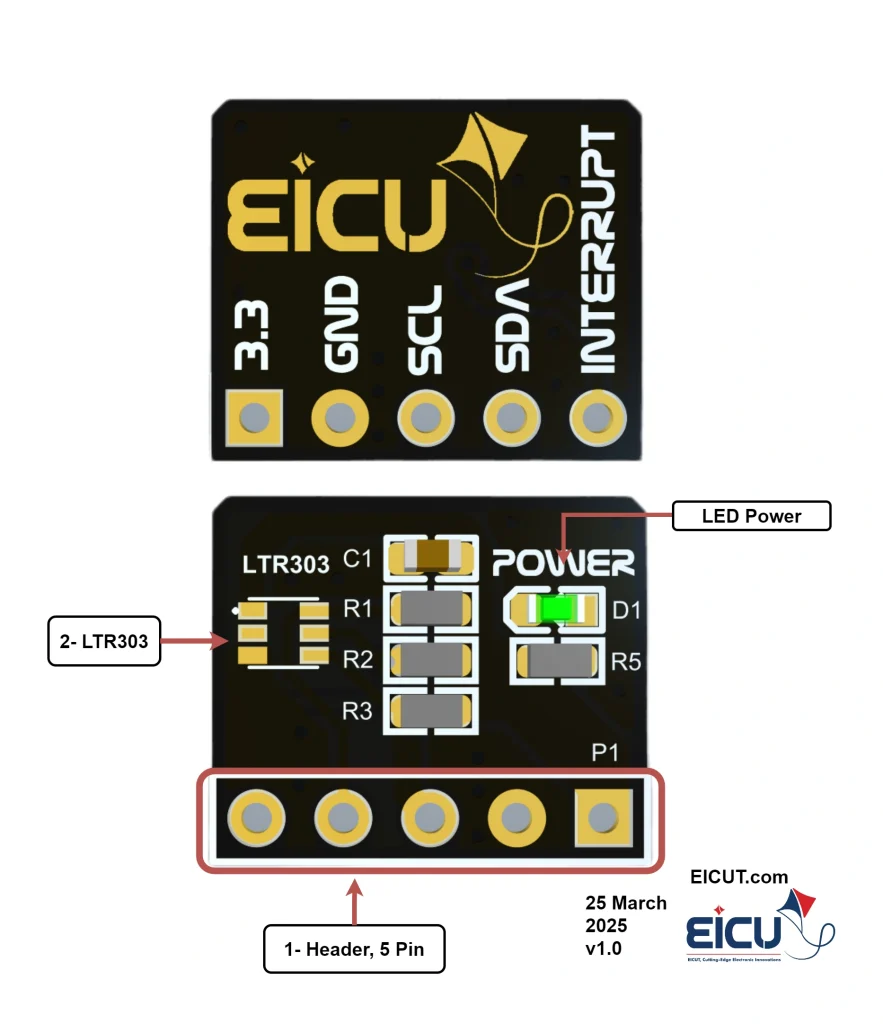
The detailed assignment of the peripheral interfaces on the board is as follows:
| NO. | Name | Silkscreen | Comment |
|---|---|---|---|
| 1 | Pin header 5 pin | P1 | header 2.54mm |
| 2 | LTR303 | LTR303 | Digital Ambient Light Sensor |
The board has 1 functional indication LEDs, as follows:
D1: Indicate Power LED
Board Interfaces #
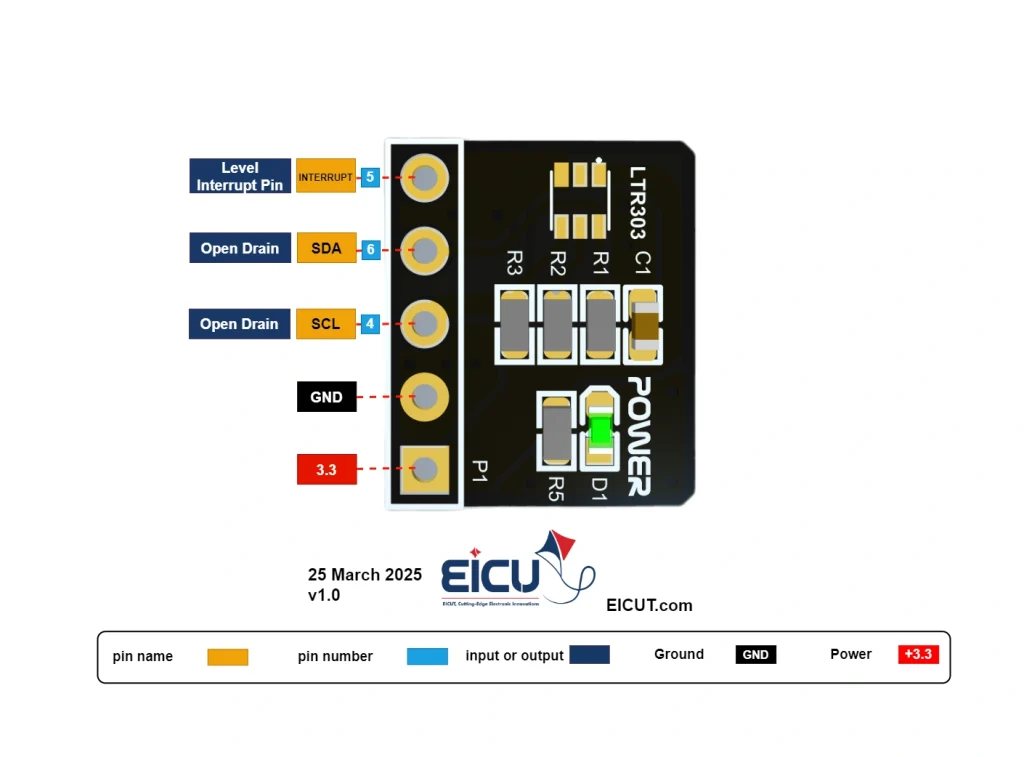
The main pin placement of the board is shown in the following figure:
Pin Header
| NO. | Name | Silkscreen | Comment | Interface |
|---|---|---|---|---|
| P1-1 | Power 3.3 | 3.3 | – | – |
| P1-2 | GND | Ground | – | – |
| P1-3 | I2C_SCL | SCL | I2C serial clock | I2C |
| P1-4 | I2C_SDA | SDA | I2C serial data | |
| P1-5 | INTERRUPT | INTERRUPT | Level Interrupt Pin. This pin is an open drain output. | – |
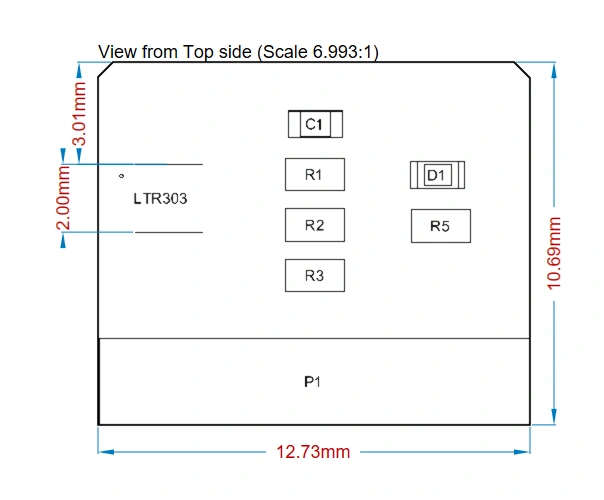
Board Dimensions #
Downloads #
FAQ #
Updated on February 15, 2026