

SIM800C Mini DB
Basic Overview #
The SIM800C Mini DB is a compact and portable board designed specifically for breadboard. The main equipped modules are the SIM800C Mini DB series wireless communication modules.
Feature List #
Module Features #
- Frequency Bands: 850/900/1800/1900MHz
- GPRS multi-slot class 12(default)
- GPRS multi-slot class 1~12 (option)
- Dimensions: 17.6*15.7*2.3mm
- Weight: 1.3±0.1g
- Supply voltage: 3.4 ~ 4.4V
- Operation temperature:-40℃ ~85℃
- Compliant GSM phase 2/2+: Class 4 (2W @ 850/900MHz)
- Compliant GSM phase 2/2+: Class 1 (1W @ 1800/1900MHz)
- Control via AT commands (3GPP TS 27.007, 27.005 & SIMCom enhanced AT Commands)
- Low power consumption
- GPRS mobile station class B
MiniDB Features #
- Compatible with BreadBoard
- On Board 2A Switching Regulator
- On Board NanoSIM(4FF) socket
- BT Antenna on board
- GNSS active antenna circuit
Development Board Resources #
Function Description #
The detailed assignment of the peripheral interfaces on the Development board is as follows:
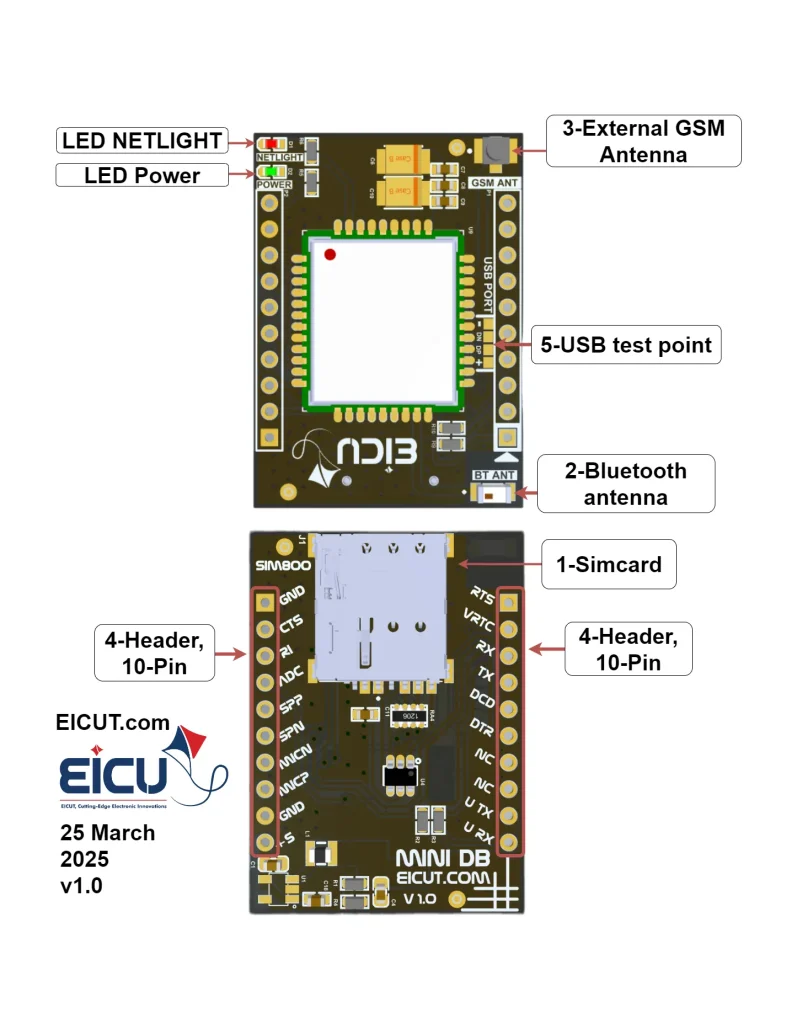
| NO. | Name | Silkscreen | Comment |
|---|---|---|---|
| 1 | Sim card case | J1 | 4FF SIM Card 12.3 × 8 mm |
| 2 | External Bluetooth Antenna | BT ANT | Johanson Bluetooth Antenna |
| 3 | External GSM Antenna | GSM ANT | UFL ANTENNA |
| 4 | 10pin | P1-P2 | Header 2.54 mm |
| 5 | USB | USB PORT | USB interface for debugging and firmware upgrades |
- D1: NETLIGHT
- D2: Power indication LED
Development Board Interfaces #
The main pin placement of the Development board is shown in the following figure:
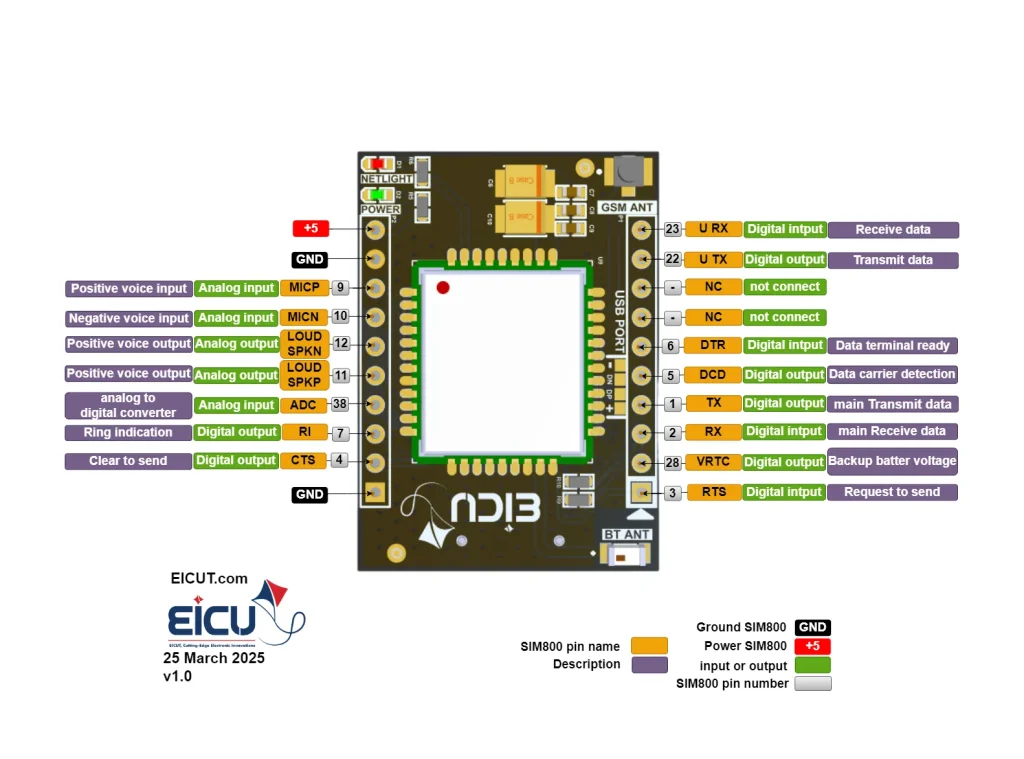
| NO. | Name | Silkscreen | Comment |
|---|---|---|---|
| P1-1 | Request to send | RTS | You can use it as an output and input. |
| P1-2 | VRTC | VRTC | Power supply for RTC when VBAT is not supplied for the system. Charging for backup battery or golden capacitor when VBAT is applied. For the allowed voltage and current values for this pin, see the bottom of the table. |
| P1-3 | RXD | RX | Receive data |
| P1-4 | TXD | TX | Transmit data |
| P1-5 | DCD | DCD | Digital output |
| P1-6 | DTR | DTR | Digital input |
| P1-7 | NC | NC | Not connect |
| P1-8 | NC | NC | Not connect |
| P1-9 | UART2-TX | AUXTX | Transmit data |
| P1-10 | UART2-RX | AUXRX | Receive data |
| P2-1 | Ground | GND | – |
| P2-2 | CTS | CTS | Clear to send |
| P2-3 | RI | RI | Ring indication |
| P2-4 | ADC0 | ADC | General purpose analog to digital converter. Vmax=2.8V, Vmin=0V |
| P2-5 | SPK1P | SPP | Channel 1 positive voice output |
| P2-6 | SPK1N | SPN | Channel 1 negative voice output |
| P2-7 | MICN | MICN | Negative voice input |
| P2-8 | MICP | MICP | Positive voice input |
| P2-9 | Ground | GND | – |
| P2-10 | Power | +5 | Main power supply of module. Make sure that supply sufficient current in a transmitting burst typically rises to 1.6A. Vmax=4.8V, Vmin=5.5V |
VRTC pin voltage: VImax=3.3V, VImin=1.5V, VInorm=2.8V
VOmax=3V, VOmin=2V, VOnorm=2.8V IOmax=2mA Iin≈10uA
🔗Hint
Make sure the power supply voltage is stable.
The board should power up and turn on automatically without the need for a turn-on function.
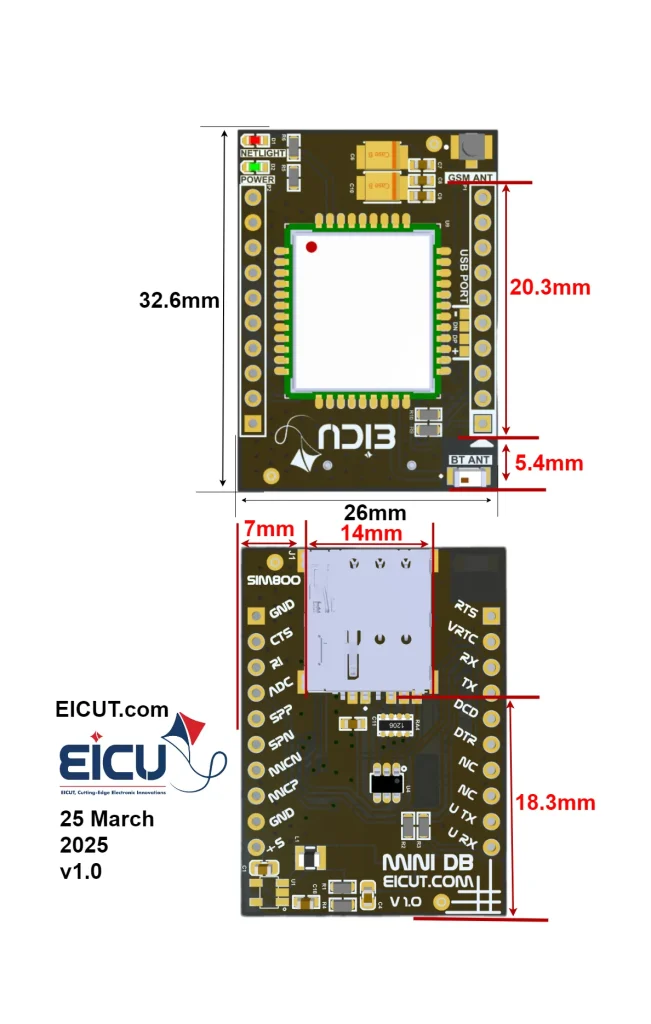
Board Dimensions #
Resource Download #
FAQ #
Updated on February 15, 2026


