
GNSS Evaluation Board Series B
Basic Overview #
The GNSS EVB (B) Board is a fully featured evaluation platform that allows you to explore and utilize all the capabilities of the GNSS module. Since all the necessary components for powering and operating the GNSS module are integrated on the board, you can easily communicate with the module by simply connecting a single USB cable for both power and data. A passive GPS antenna is built into the board to enable quick startup. However, if needed, you can connect an active antenna via the onboard u.FL connector. A convenient switch is provided to easily toggle between the passive and active antennas.
Supported Module List #
- Quectel L26DR
- Quectel L26
- Quectel LC29H
- Quectel LC29T
Feature List #
Key highlights of the board include:
- Built-in GNSS Passive Antenna
- fl Connector for Active Antenna
- RF Swtich for ANT (between Passive & Active)
- USB-to-Serial converter with Micro-USB port for easy debugging and logging
- Level shifter (To 3V3 OR 5V)
- RTC SuperCap
The features and design of this board make it an excellent choice both for getting started and for professional use of GNSS modules.
GNSS EVB (B) Resources #
Function Description #
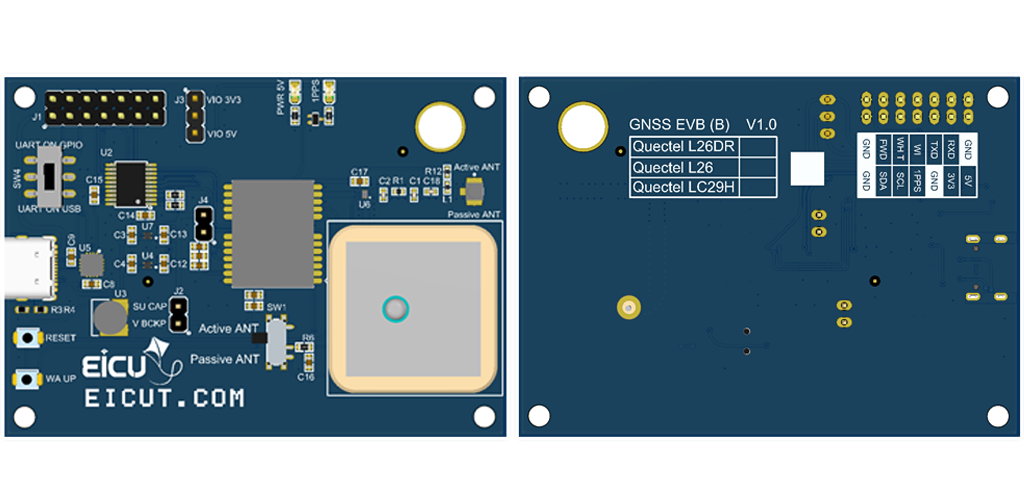
The main component and interface placement of the evaluation board is shown in the following figure:
Board Interfaces #
Following Figure indicates the interface definitions of the GNSS Evaluation Board Series B.
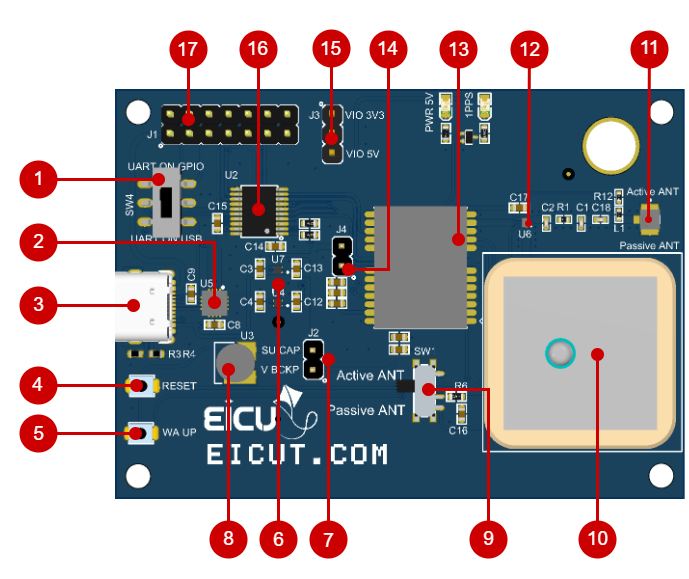
| Item NO. | Interface | Description |
|---|---|---|
| 1 | Slide Switch | Switch UART1 of GNSS Module between 14-pin Header and USB TTL Converter |
| 2 | USB TTL | CH343P USB TTL Converter |
| 3 | USB TYPE-C | USB TYPE-C – can be used for both power supply and data transmission with GNSS module UART |
| 4 | Push Button | RESET option – connected to RESET pin on the GNSS module |
| 5 | Push Button | Wake Up – connected to Wake Up pin on the GNSS module |
| 6 | Regulator | Two regulators to supply board parts |
| 7 | Jumper Cap | Connect and disconnect Super Cap to the module |
| 8 | Super Cap | Super Capacitor for VCC backup supply of GNSS Module |
| 9 | Slide Switch | Slide Switch to change RF input path of GNSS Module between on-board GNSS passive antenna and u.FL connector (for GNSS active antenna) |
| 10 | Antenna | GNSS Passive Antenna (on-board) |
| 11 | U.FL Connector | U.FL connector for connecting GNSS Active Antenna |
| 12 | RF Switch | SPDT RF Switch IC – switches between active and passive antenna input signals |
| 13 | GNSS Module | Main GNSS Module |
| 14 | Jumper Cap | Jumper to connect / disconnect VCC of GNSS Module |
| 15 | Jumper Cap | Jumper to change IO voltage of 14-pin Header between 3.3 V and 5 V |
| 16 | Level Shifter | Logic Level Shifter – for connecting module IO to other circuits with different logic levels |
| 17 | 14 Pin-Header | 14-pin Expansion IO connector |
14pin Header #
| PIN NO. | Marking | Description |
|---|---|---|
| 1 | 5V | 5V input – Voltage to supply board power. Connected directly to USB VBUS |
| 2 | GND | Ground |
| 3 | 3V3 | 3.3V output – Voltage to supply external circuits or as voltage reference (max 300 mA) |
| 4 | RXD | Connected to GNSS module RXD pin through level shifter |
| 5 | GND | Ground |
| 6 | TXD | Connected to GNSS module TXD pin through level shifter |
| 7 | 1PPS | Connected to GNSS module 1PPS pin through level shifter |
| 8 | 3D F | Connected to GNSS module 3D Fix pin through level shifter (check module datasheet for supported function) |
| 9 | SCL | Connected to GNSS module SCL pin through level shifter |
| 10 | JAM I | Connected to GNSS module JAM IND (Jamming Indication) pin through level shifter (check module datasheet for supported function) |
| 11 | SDA | Connected to GNSS module SDA pin through level shifter |
| 12 | GEOF | Connected to GNSS module Geofence pin through level shifter (check module datasheet for supported function) |
| 13 | GND | Ground |
| 14 | GND | Ground |
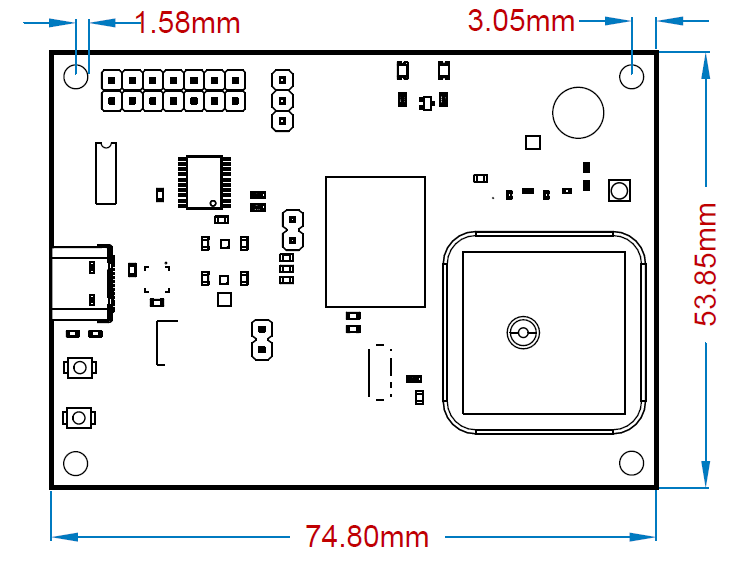
Board Dimensions #