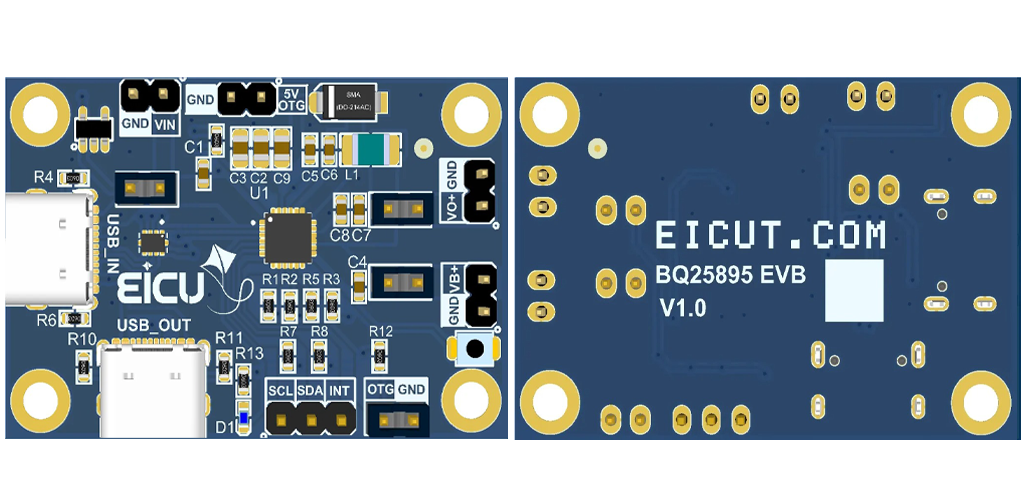
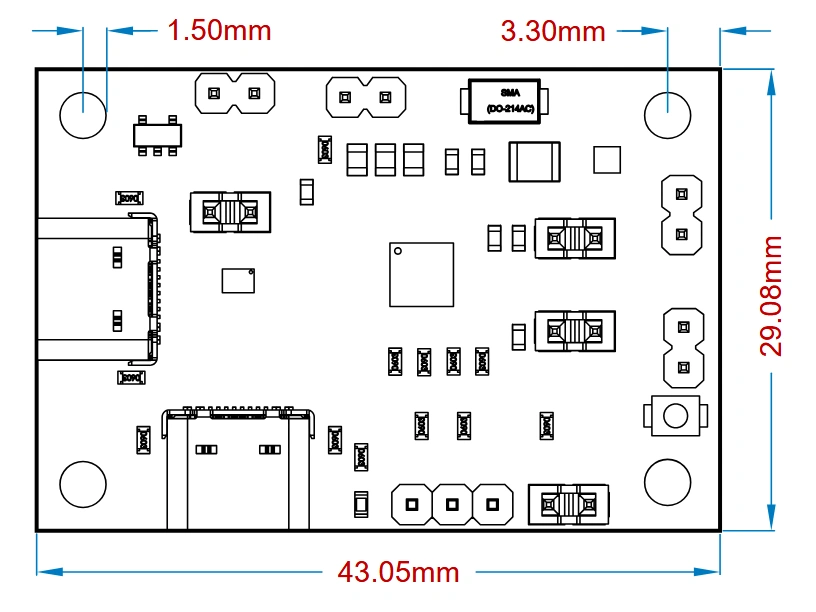
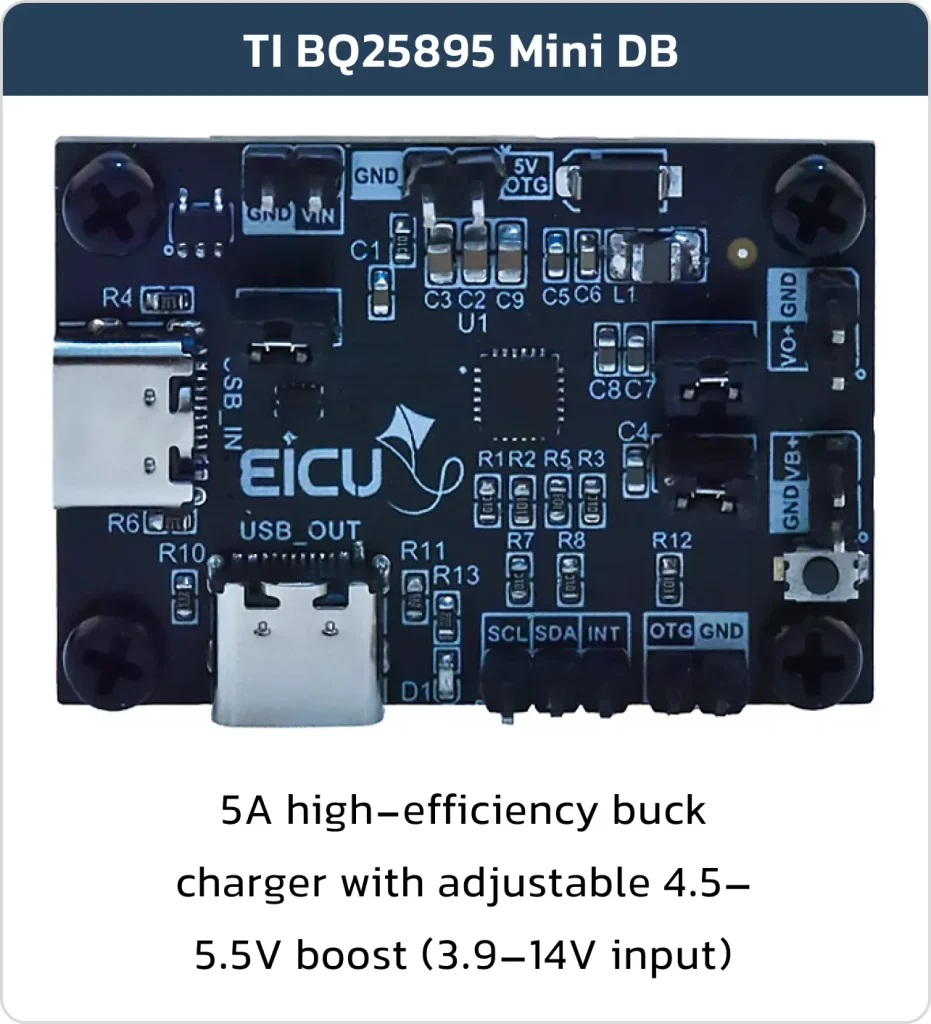
The BQ25895 Evaluation Board is a complete charger module for evaluating the highly-integrated switch-mode battery charge management and system power path management device for 1 cell Li-Ion and Li-polymer battery in a wide range of smartphone and tablet applications.
A compact, fully-featured test platform for the Texas Instruments BQ25895 — 5 A single-cell switch-mode charger with NVDC power path, I²C control, USB OTG boost, and high-speed USB data switching.
What charging current does it support?
Up to 5 A input current and 3.5 A charging current from a 5–14 V source (USB PD, QC3.0, or standard adapter). Perfect for fast-charging smartphones and tablets.
Does it support USB Power Delivery (PD)?
Yes — the BQ25895 natively supports USB PD and QC3.0. Connect a PD charger to the input USB-C and the chip will negotiate up to 14 V automatically.
Can I use it as a USB OTG power bank?
Yes — enable OTG Boost mode via the dedicated jumper or I²C. The board outputs 5 V / 3 A from the battery on the “Boost Output” pins.
What is the high-speed USB switch for?
It allows USB 2.0 data to pass from the downstream USB-C port directly to your phone/tablet while charging — ideal for debugging or file transfer during fast charging.
How do I configure the charger (current, voltage, etc.)?
Via I²C interface (SCL/SDA pins are broken out). Use any microcontroller (Arduino, ESP32, etc.) or TI’s GUI software with a USB-to-I²C adapter.
What do the LEDs indicate?
• PG: Input power good
• CHG: Charging in progress
• DONE: Charge complete
• FAULT: Fault condition (over-voltage, thermal, etc.)
Can I disconnect the battery while the system is running?
Yes — thanks to NVDC power path. The system load is supplied directly from the input adapter even if the battery is removed.
Is the board safe for Li-Ion batteries?
Absolutely — includes JEITA, thermal regulation, input OVP, battery OVP, charge timer, and short-circuit protection.
Can I integrate this board into my own design?
Yes — all critical pins (SYS, BAT, VBUS, OTG, I²C, INT, etc.) are broken out to headers. Use it as a reference design or directly embed it.